
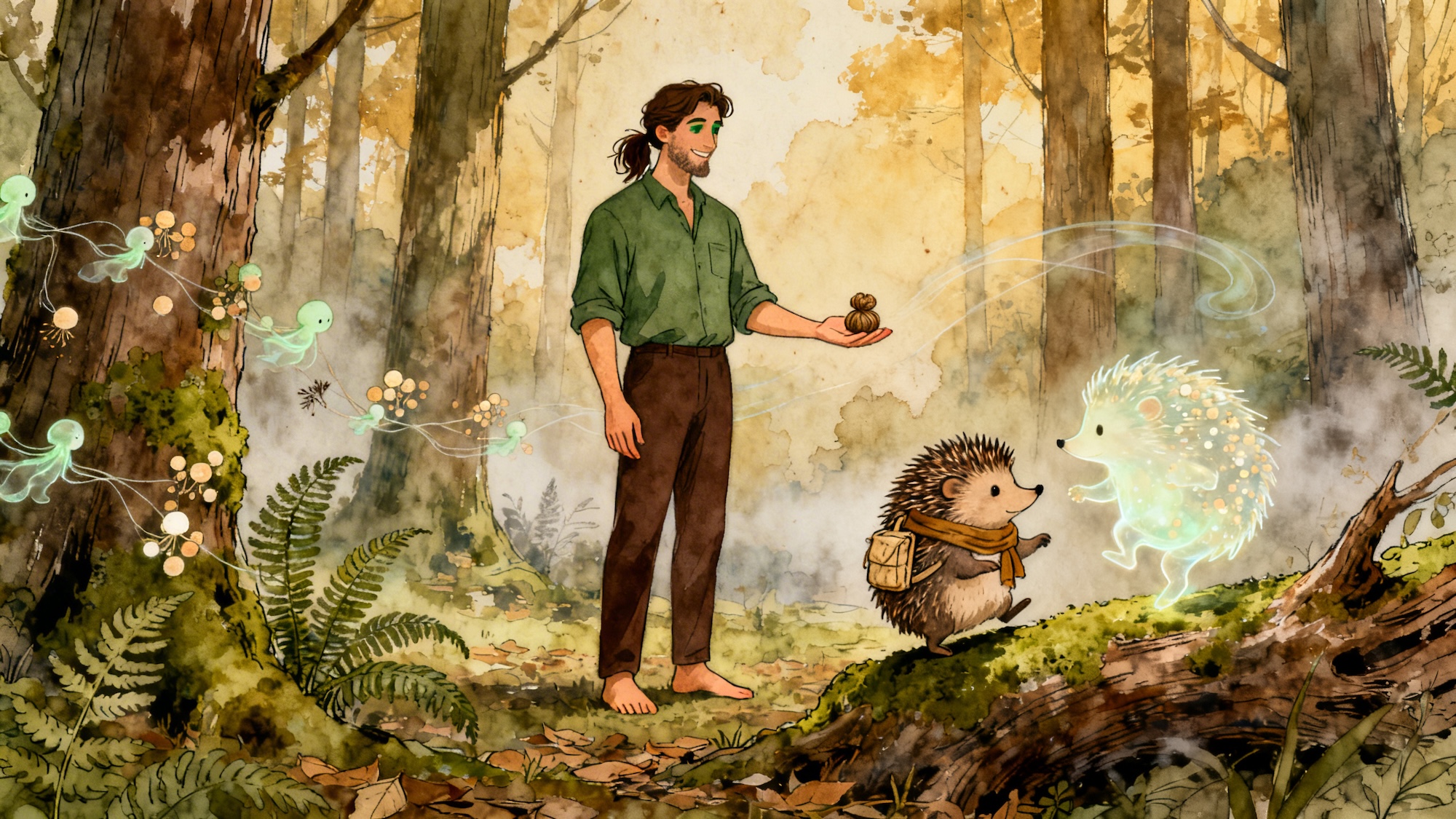

Animism: A Practice of Relationship
A grounded look at animism as a practice of attention and relationship—exploring its history, Northern European roots, and how it informs embodied, non-directive bodywork at Wild Hart.

Published On:
February 1, 2026
The world does not ask us to believe in it.
It asks only that we listen—
with skin, with breath, with care.
Animism is often described as a belief system, but that description points in the wrong direction. Animism is less about what a person believes and more about how a person relates. It is not a doctrine, nor a set of supernatural claims. It is a way of attending to experience—one that recognizes relationship as fundamental.
At its simplest, animism is the recognition that experience arises through interaction: between body and world, sensation and story, perception and meaning. It is an orientation that predates philosophy and survives it, quietly present wherever people notice that life feels responsive when they slow down enough to pay attention.
Animism appears across human history in many forms and in many places. It is not owned by any one culture, religion, or lineage. Wherever humans have lived closely with land, weather, animals, and one another, animistic ways of relating have emerged.
Across continents and eras, animism has shown up not as a single shared mythology, but as a shared pattern of attention. The details vary widely—shaped by ecology, culture, and history—but the underlying gesture is the same: the world is not experienced as inert. It is encountered as something we are in relationship with.
In this sense, animism is not a belief about spirits. It is a deeply human capacity to experience the world as participatory. Children display it naturally. Artists and craftspeople rely on it. Anyone who has ever sensed that a place “felt different” before knowing why has brushed up against it.
Animism does not require agreement or faith. It arises from lived experience.
Rather than asking what is alive, animism asks how we are relating.
Its primary mechanics are simple, though not always easy:
Animism shifts the center of gravity away from certainty and toward presence. It notices how meaning emerges not from isolated thought, but from the interplay of sensation, emotion, memory, and environment.
This orientation does not reject reason. It simply refuses to let explanation override experience.
Humans make sense of life through narrative. We tell stories about who we are, what has happened to us, and what we expect from the world. These stories are not just mental constructs. They live in the body.
A held breath.
A braced shoulder.
A stomach that tightens before words arrive.
These are not metaphors. They are physical expressions of lived meaning.
Animism offers a way to meet narrative without trying to correct or replace it. Rather than asking whether a story is true or false, animistic attention asks how the story is felt. Where it lives. How it moves. How it changes when it is noticed rather than resisted.
Narrative, in this sense, is not something to solve. It is something to listen to.
In an animistic frame, the body is not an object to be fixed. It is a site of ongoing relationship—between past and present, inner and outer worlds, sensation and meaning.
Tension is not merely mechanical.
Relaxation is not merely physical.
Both are expressions of how the body has learned to respond to its world.
This does not mean every sensation carries a hidden message. Animism is not about decoding the body. It is about staying present long enough to notice what is already happening, without forcing interpretation.
In the modern world, animism often survives without a name. It shows up in moments of felt sense rather than belief:
These experiences do not require metaphysical conclusions. They require attention.
Contemporary animism is less concerned with spirits and more concerned with relationship—how awareness moves between body, environment, and meaning. It values responsiveness over certainty and curiosity over control.
At Wild Hart, animism is not practiced as spirituality or religion. It functions as a relational lens for body-centered work.
This means:
Symbolic tools—such as cards, imagery, or metaphor—may be used as reflective prompts. These are not used for divination or guidance. Their role is simply to help organize attention and invite reflection, much like language or imagery might.
The work remains non-directive. Nothing is imposed. Nothing needs to be believed.
In a culture oriented toward speed, productivity, and explanation, animism offers a counterbalance. It restores attention to the immediacy of experience before conclusions are drawn.
It reminds us that:
Animism does not promise answers. It offers a way of staying with questions without becoming lost in them.
Animism is not about believing that the world is alive. It is about noticing that experience feels alive when we meet it with care.
When we attend—to body, to place, to moment—relationship becomes visible. Not as something mystical, but as something deeply ordinary and deeply human.
And sometimes, that simple act of attention is enough to change how we move through the world.